Sacrificing the Many to Save the Many
2023-2024
salvaged “quarry” train diorama, archival video footage from the cockpit of Air Tanker 850, 1921 edition of King Coal by Upton Sinclair, iron pyrite or “Fool’s Gold”, PHOS-CHEK fire retardant, iron oxide, coal
from the Unearthed series
1 min video excerpt; unaltered cockpit footage


Sacrificing the Many to Save the Many (2023-2024) premiered in May 2024 in Pasadena, California as part of Unearthed—an arts-based research project funded in part by a City of Pasadena Artist Grant. The artwork is a multimedia installation featuring a plastic “Quarry” train diorama that I found in a pile of discarded objects at the trash dump during a 2023 artist research excursion to Silverton, a historic mining town in Colorado. Accompanying the train diorama is unaltered video footage from the cockpit of Air Tanker 850 as it dropped PHOS-CHEK fire retardant to stop the spread of the 2018 416-Burro Fire Complex, which was sparked by coal embers from the Durango & Silverton Narrow Gauge Railroad (D&SNGRR). The 416-Burro Fire Complex burned for over 61 days and destroyed 52,778 acres of wilderness, making it one of the worst wildfires in Colorado history.
In operation since 1882 and marveled as a historical treasure, the D&SNGRR still runs today. The company has made a concerted effort to convert from coal to recycled motor oil as the fuel for its fleet of a half-dozen active steam locomotives. Their last coal-fired engine was scheduled for conversion to oil in Spring 2024, and the Railroad paid the U.S. government a 20-million-dollar settlement for their role in the wildfire. The unedited footage from Air Tanker 850 brings forth a strange audio/visual dissonance, as the viewer witnesses massive plumes of wildfire smoke from the plane's bird's-eye view, all while hearing the pilot's upbeat radio music between intermittent, pragmatic transmissions to ground control.
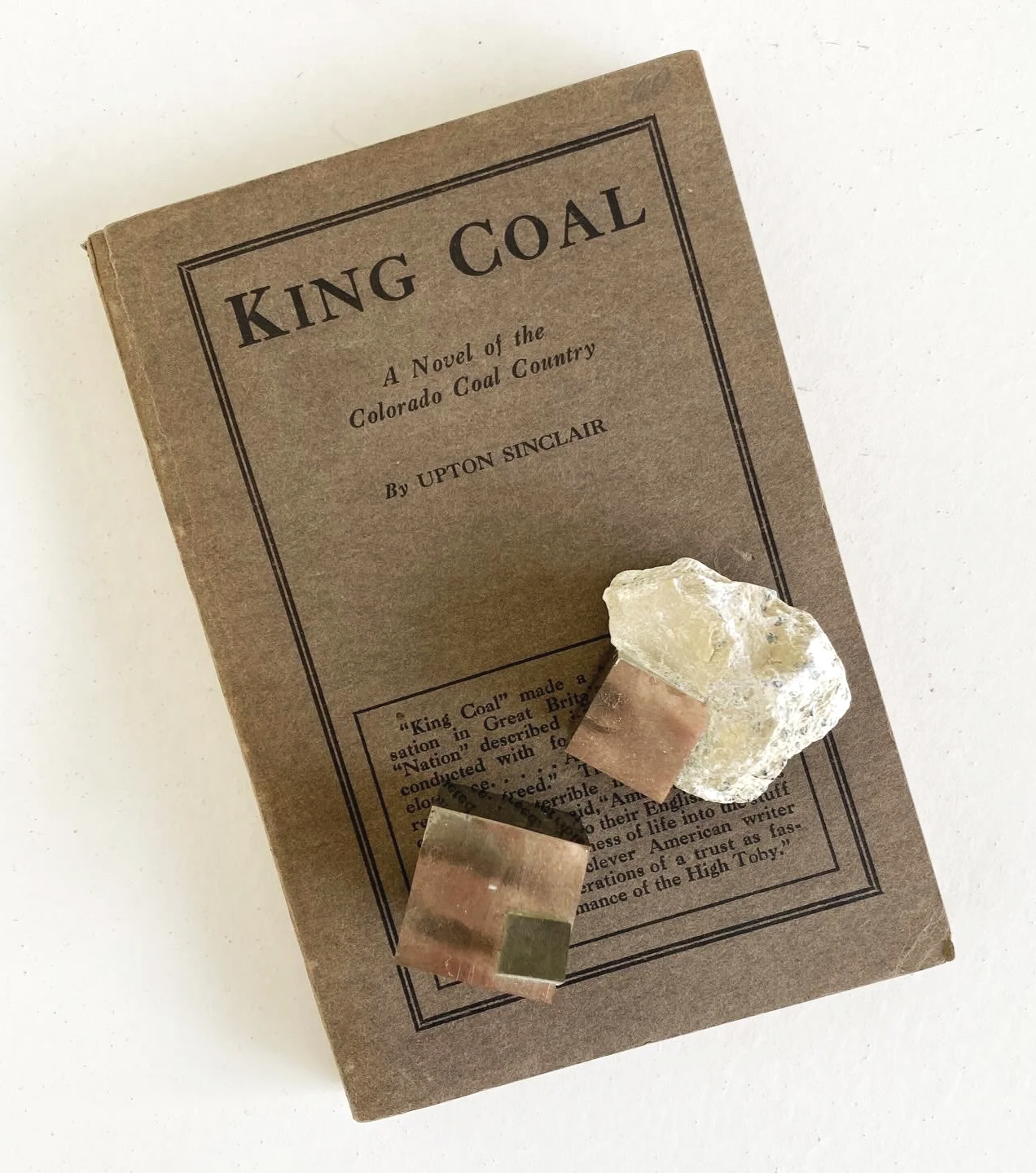
Flanking the video and “quarry” train diorama are two pedestals. On one pedestal, chunks of iron pyrite (or “Fool’s Gold”) rest atop a 1921 copy of King Coal—a novel by socialist author Upton Sinclair—which was originally published 1917 in New York but was, coincidentally, privately reprinted in Pasadena, California in 1921. The novel touches on the history of mining in Colorado and the exploitative industry’s dangerous working conditions, socio-economic repercussions, and environmental tolls. Nearby, a particularly poetic excerpt from the novel highlights the disparity between the miners, many of whom were immigrants, and the upper class, who blindly benefited from their labor.
On another pedestal, a petri dish contains lumps of coal soaking in a blood orange bath of PHOS-CHEK fire retardant. This advanced chemical technology is advertised as “the most environmentally friendly fire retardant on the market.” However, the scientific community is currently considering whether PHOS-CHEK does more harm than good, as concerns have been raised that the product causes eutrophication, kills fish and other aquatic life, and causes long-term effects on soils, insects, and microbiology.
In fact, an environmental ethics group sued the U.S. Forest Service for its use of PHOS-CHEK, claiming the Service violated the Clean Water Act by spraying the retardant without assessing the product's harmful effects on waterways. In 2023, a Montana judge agreed that the U.S.F.S. was violating the Clean Water Act but declined to prohibit the agency from using PHOS-CHEK, instead requiring the Service to apply for a permit from the Environmental Protection Agency, but allowing the U.S.F.S. to continue using the product in the meantime. Further linking these issues to my home state of California, PHOS-CHEK is produced in Southern California and is the leading product used by CalFire for fire prevention across the state.
In all, Sacrificing the Many to Save the Many confronts nuanced and entangled events across time periods and geographies, interrogating the legacy of exploitative industries and laying bare the perversity and precarity of our current and future environmental realities.